
Beyond answers: How AI can expand human thinking
By Frauke Bröcker
Some time ago, I was in Athens on business. One day, I noticed a stage being set up in a public square. When I asked what was happening, someone told me there would be an event about history that evening, followed by live music. That sounded interesting, so I decided to go.
The evening began with a presentation. Historical photographs and documents appeared on a screen while a speaker talked about them. There was just one problem: the entire event was in Greek, and I don't speak Greek. Όχι (Greek for 'no').
Normally, I would probably have left after ten minutes. I could have looked at the pictures, but without the explanations, the historical context would have remained inaccessible to me.
This time, I stayed.
I started taking photographs of the slides and asking GPT to explain what I was looking at and what the presentation was about.
That was how I discovered that the event was about the Asia Minor Catastrophe. I have to admit that, until that evening, I had never heard of it.
It was about the displacement and flight of Greek populations from Asia Minor, the subsequent population exchange between Greece and Turkey, suffering, hunger and the loss of home. But also about international relief efforts, including those from the United States.
As the presentation continued, I began asking GPT questions. Not just about the historical events themselves, but also about their cultural consequences.
I had noticed before, for example, that Greek cuisine includes dishes such as kebab and hummus, or ingredients such as tahini, which I had associated more with regions further east. Suddenly, I began to understand historical connections between migration, cultural exchange and culinary traditions.
This reminded me of the Spatial Turn, a shift in perspective in the humanities and social sciences in which space is no longer regarded merely as a geographical backdrop. I began discussing with GPT how spaces are created and transformed through human relationships, movements and social processes.
Suddenly, Greece no longer appeared to me simply as a country with a particular national culture, but as part of a much larger cultural space that had developed over centuries, with connections still visible today in its food, music and everyday life.
An evening I would normally have abandoned after a short time had turned into a journey of discovery through history, migration, music and culture.
Even without a translation of the hour-long presentation in Greek, the subject had become accessible to me.
GPT enabled me to ask questions that, without that access, would probably never have occurred to me.
And that, to me, is one of the most interesting possibilities of artificial intelligence: it can do more than make existing tasks easier. It can expand the range of things people are able to explore, understand and connect.
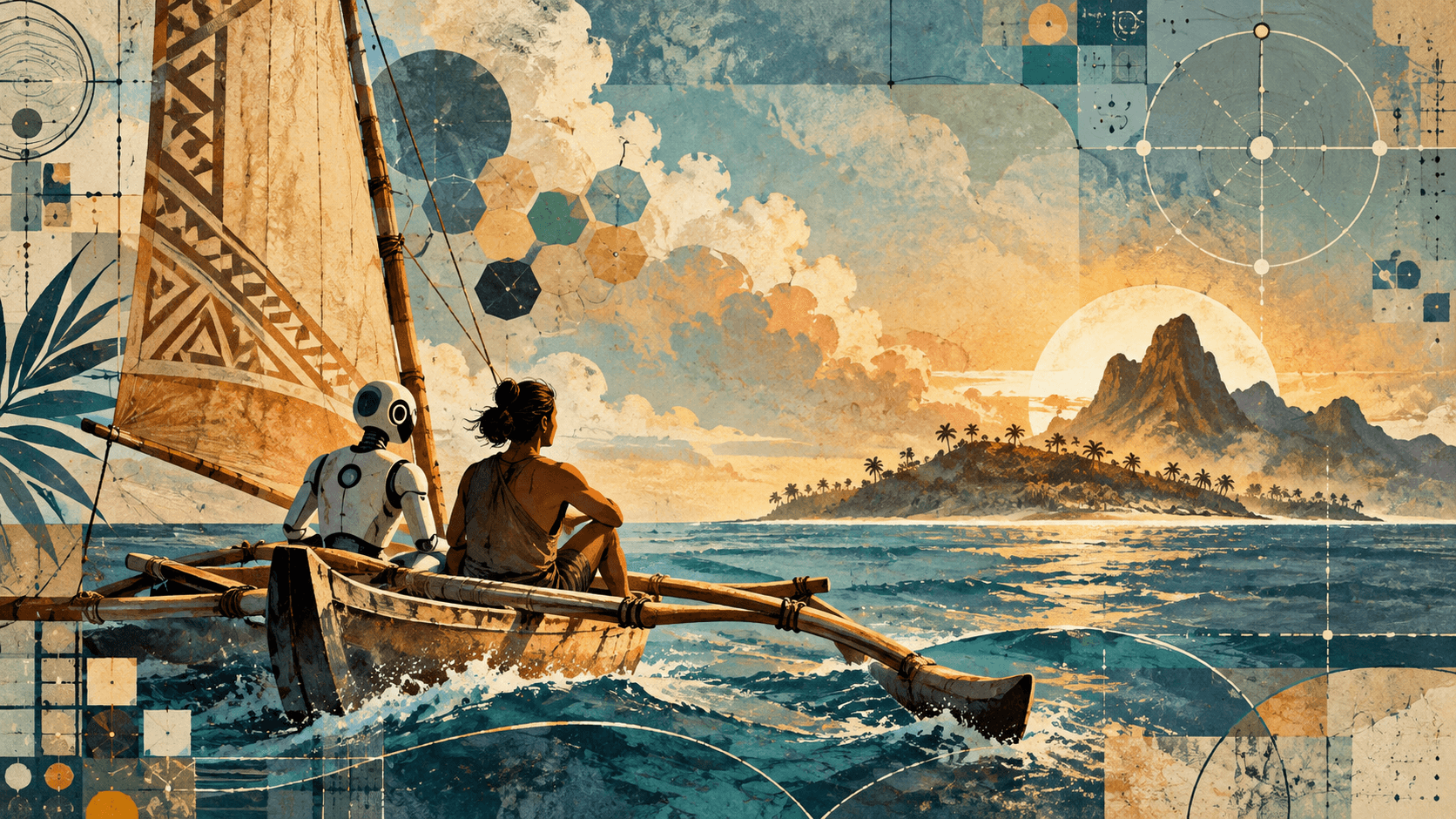
Since I started working with AI, I have learned an incredible amount. To me, it is a little like the Polynesian navigators. They travelled vast distances across the Pacific long before modern navigation instruments existed. They found their way using stars, wave patterns, birds and even cloud formations that could indicate an island beyond the horizon.
You see a cluster of clouds somewhere on the horizon, follow it, and perhaps discover an island you weren't originally looking for.
Knowledge Without Borders
Today, I have access to scientific knowledge that was often expressed in specialist language I would once have struggled to understand as someone without a scientific background. And even for scientists, it is becoming easier to look beyond the boundaries of their own disciplines and discover findings and connections from other fields.
That reminds me of another Greek: Aristotle. His drawers, into which he sorted different areas of knowledge, had a profound influence on the development of science. Over the centuries, we have created more and more drawers, each one increasingly specialised. This has made enormous progress possible, but it can also make it difficult to recognise connections between different disciplines.
I believe AI can help us reconnect those drawers. Not by abandoning specialisation, but by making the boundaries between different fields of knowledge more permeable.
And perhaps we should go one step further and consider not only the boundaries between scientific disciplines, but also those that prevent people from accessing knowledge in the first place.
One example comes from Malawi.
There, an AI-powered advisory system called Ulangizi AI has been developed for smallholder farmers. Farmers can ask questions about their crops or livestock, including in the local language, Chichewa. They can, for example, submit photographs of diseased plants and receive advice on possible causes and treatments.
The system combines AI with agricultural expertise and local information. It aims to reach people who have previously had only limited access to professional agricultural advice.
Journalist Stephanie Wangari describes what this can look like in practice in an article for Rest of World. An older farmer was having problems with aphids on her okra plants. The usual methods and advice from people around her had not helped. With the assistance of an intermediary, she was able to ask Ulangizi AI her question in Chichewa. She received advice on how to treat the problem, followed it, and her plants recovered.
The woman owned neither a smartphone nor a computer. Yet she was still able to benefit from the system.
Knowledge often exists, but it is not available where it is needed. Language, distance, inadequate infrastructure and limited advisory services create barriers. AI can help overcome them.
In Athens, AI gave me access to a historical and cultural world that would otherwise have remained largely closed to me. In Malawi, it can enable a farmer to access knowledge that was previously beyond their reach. And in science, it can help connect findings from different disciplines.
More Than the Sum of Its Parts
But how can we actively encourage people and AI to combine their different abilities, rather than simply outsourcing tasks to machines?
Humans bring experience, needs, curiosity, goals and the ability to give meaning to things. AI can process large amounts of information, reveal connections, bring together knowledge from different fields and offer new perspectives.
Through this collaboration, insights and possibilities for action can emerge that neither the human nor the AI system would have been able to access in quite the same way independently.
From the perspective of complex systems, we can formulate the following hypothesis: the interaction between humans and AI may give rise to emergent capabilities and possibilities that neither could achieve independently. In this sense, the whole may become more than the sum of its parts.
That, to me, is the truly exciting idea. Not whether AI will replace humans, but what new possibilities might emerge from the interaction of different capabilities.
AI expands the range of human possibilities: personally, socially and scientifically.
Learning to Ask New Questions
But this expansion does not happen automatically.
The same technology that helps me discover new connections can also be used to relieve me of as much thinking as possible. I can ask AI to read, summarise, write and prepare decisions for me, without seriously engaging with the content myself.
The human brain tends to avoid effort when tasks can reliably be outsourced. We already know this from phone numbers we no longer memorise, or navigation systems we follow without remembering the route.
With AI, this outsourcing increasingly extends to more complex cognitive activities.
This presents us with two possible developments: cognitive offloading and cognitive augmentation. The outsourcing of mental work on the one hand, and the expansion of cognitive capabilities on the other.
Both can happen with the same technology. What matters is not only what AI can do, but also how people learn to work with it.
Perhaps, then, we should spend less time debating whether AI makes us smarter or less intelligent, and much more time asking under what conditions it strengthens our abilities or allows them to deteriorate.
How do we learn to learn with AI? How can we use it in ways that do more than provide answers, but also enable new questions? How do we combine human and machine capabilities without neglecting our own?
These questions concern not only schools and universities, but also science, the workplace, professional development and, ultimately, lifelong learning.
They also concern our responsibility as a society. Just because something becomes technically possible does not mean it should automatically be delegated to AI. Which decisions people want to make themselves, which tasks they are willing to entrust to systems, and under what conditions, are questions of social design and governance.
Perhaps the most important skill in working with AI, then, is not writing the best possible prompts or getting the best possible answers. Or asking it to translate my German thoughts into English for this very blog post.
It is learning what new questions we can ask.
Like the Polynesian navigators who ventured out onto the vast ocean without knowing whether there was only water beyond the horizon or entirely new worlds. They noticed signs, followed them and reached shores they had not been able to see.
Perhaps we need precisely that spirit of exploration in our relationship with AI. The curiosity to follow a question wherever it leads, discovering unexpected connections along the way. To build associative bridges between fields of knowledge, adopt new perspectives and find words for the previously invisible spaces between our thoughts.
Not merely to reach conclusions faster, but because discovery itself is exciting and makes the process of thinking feel alive.
And perhaps that is where the real potential of this collaboration lies: the feeling of reaching an entirely new shore, one that is not merely calculated, but explored together.
Source for the example from Malawi: Stephanie Wangari (23 October 2025), “Malawi’s new farmhand: AI that speaks the local language”, Rest of World.